How Harvest Works
Start with your address, then learn what each organization controls and where to go for help.

Harvest HOA
The Harvest HOA manages the shared neighborhood experience and the private rules attached to Harvest homes.
You may encounter it through a pool rule, an amenity announcement, HOA dues, common-area landscaping, or a letter about your fence, paint, yard, roof, or another exterior feature.
FirstService Residential is the company hired to manage it day to day. FirstService staff run the HOA office, manage amenities, handle resident questions, oversee vendors, and run the lifestyle program.
Homeowners elect representatives, and Hillwood, the developer, has two seats.

Hillwood
Hillwood is still the master developer of Harvest. The residential community is not quite finished.
By 2005–2006, Realty Capital-related companies owned much of the land. In late 2011, Realty Capital and Hillwood Communities formed a joint venture to develop the roughly 1,000-acre property.
Hillwood had been building master-planned residential communities since 1988. By 2011, it had developed tens of thousands of home lots in dozens of communities. Hillwood says the final phases are still being developed and expects the remaining homesites to sell out around 2028.

Your Belmont District
Every Harvest home is served by District 1 (generally west of Harvest Way) or District 2 (generally east of Harvest Way).
Belmont Fresh Water Supply Districts No. 1 and No. 2 are local governments created while Harvest was being planned. Their elected boards make public decisions that can directly affect your home and tax bill.
- District property taxes and bond debt used to finance Harvest infrastructure
- Neighborhood roads, sidewalks, drainage, and streetlights within the district
- Trash, police, and animal-control agreements made on behalf of residents
- District-owned parks and recreational areas, depending on the district
- Major infrastructure, repair, and spending decisions approved by the elected board
This is why Belmont appears in conversations about taxes, roads, drainage, trash service, police coverage, and major neighborhood projects.

Denton County
Every Harvest resident lives in Denton County, even when a mailing address says Argyle.
The county runs countywide elections, courts, records, tax collection, and other public services. The Denton County Sheriff is also the standard law-enforcement agency for unincorporated areas (like Harvest that is not technically Northlake or Argyle). Although Belmont District 1 currently has a separate police contract with Northlake.

Denton County ESD Nos. 1 and 2
Every Harvest home is covered by both emergency-services districts and pays a separate property-tax line to each one.
ESD No. 1 operates the fire department and the shared Fire & EMS system. ESD No. 2 funds and oversees emergency medical and ambulance service. They use the same stations and personnel, but they remain separate public districts with separate boards, budgets, and tax lines.
Each district has a five-member board appointed by Denton County Commissioners Court. Unlike the Belmont boards, Harvest residents do not elect the ESD commissioners. The boards often hold one joint public meeting, then take separate votes.
Your school district
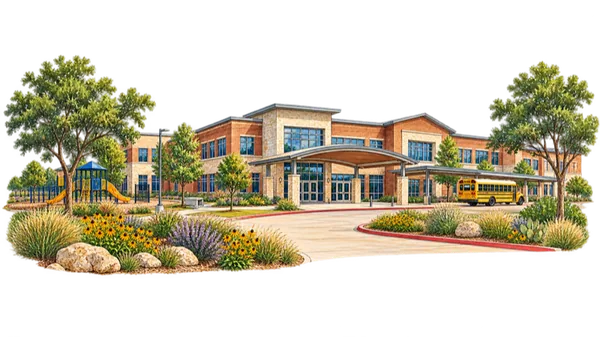
Harvest homes are assigned to Argyle ISD or Northwest ISD based on the school boundary for the address.
Your school district manages campuses, attendance zones, local curriculum choices within state rules, buses, staff, and the school-district portion of your property taxes.
Northlake and Argyle
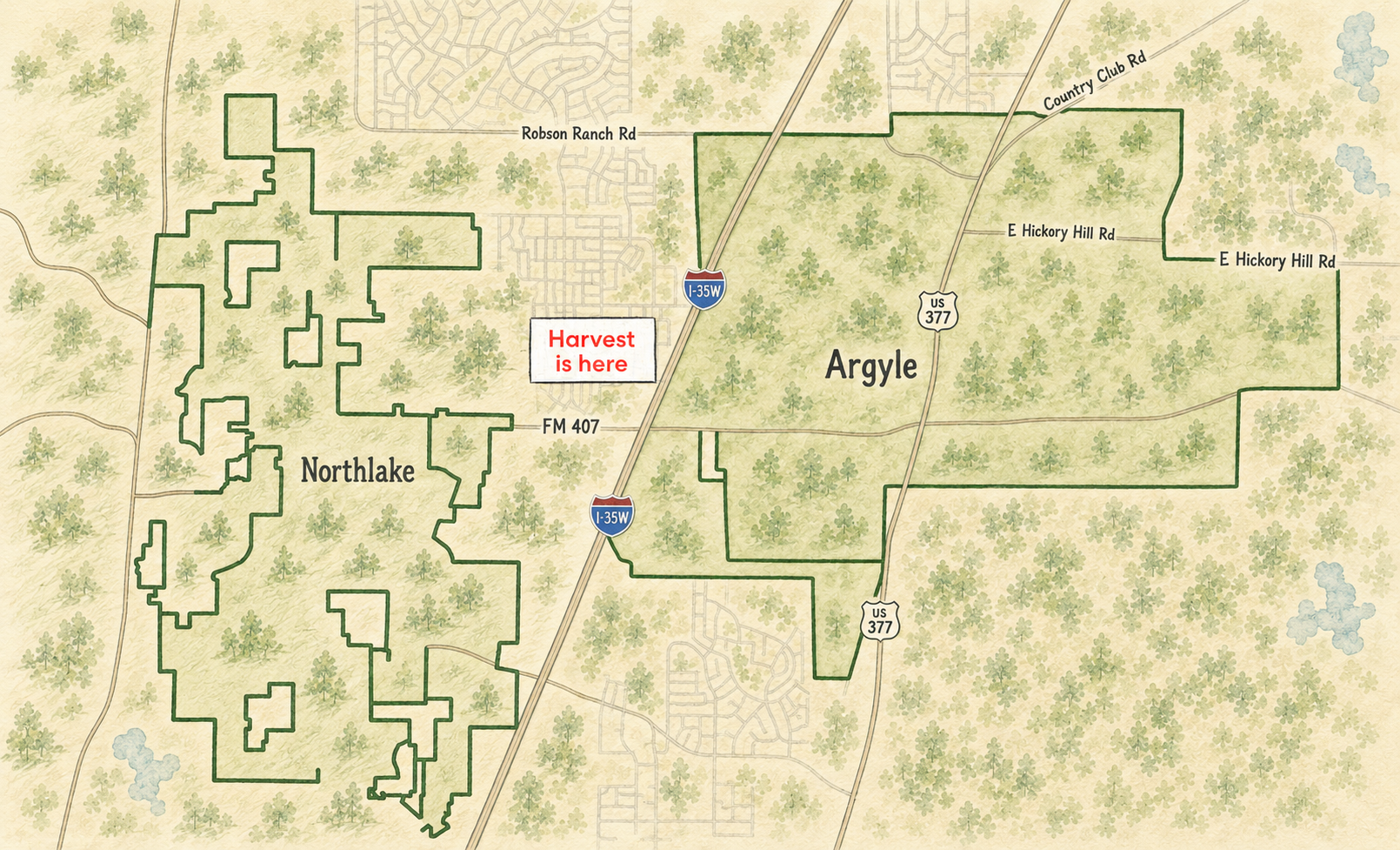
Northlake and Argyle are actually neighboring towns. Most Harvest homes are outside both towns’ legal boundaries and are unincorporated.
Almost all of Harvest sits in a town’s ETJ, which means extraterritorial jurisdiction. Northlake and Argyle have some limited influence over development connections, drainage, roads, water, wastewater, or how land is divided due to proximity. But we are not town residents or allowed to vote in their local elections.
A Northlake or Argyle mailing address does not mean that a home is inside that town.
Contracts, tax rates, roads, and agreements can move through public meetings
A proposal mentioned at a meeting is not automatically approved. The live tracker separates active discussions, pending decisions, completed work, and long-term questions.